
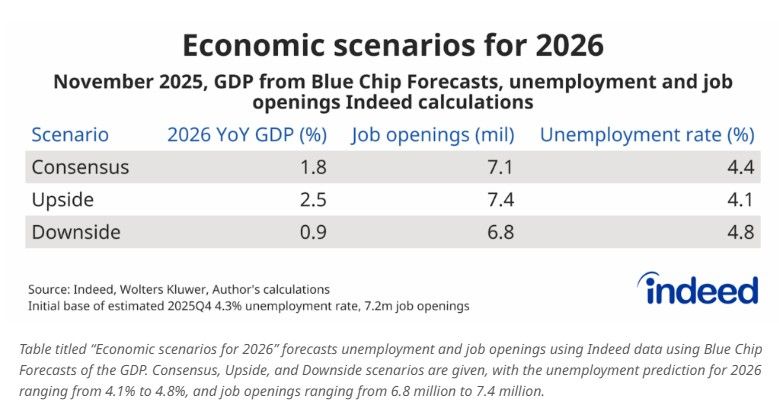
Hiring Lab constructed consensus, upside, and downside scenarios that estimate the unemployment rate and the level of job openings at the end of 2026. These scenarios were informed by Wolters Kluwer’s Blue Chip 2026 GDP growth forecasts, an aggregation of forecasts from economists and financial professionals.
The Blue Chip Consensus Scenario is derived from Blue Chip’s November 2025 consensus forecast for 2026 real GDP growth, which averaged 45 economist forecasts. For the Upside Scenario and Downside Scenarios, we use the average of the top ten and bottom ten forecasts for real GDP growth, respectively. It is important to note that these do not represent the best and worst case scenarios for the economy; instead, they are illustrative of slightly more positive and negative outlooks than the consensus average. From these GDP growth forecasts, we then used known historical relationships between economic growth and labor market performance to estimate both the unemployment rate and the number of job postings at year-end 2026. Further details can be found in the methodology section at the end of this report.
The Blue Chip consensus forecast for real GDP annual growth in 2026 is currently 1.8%, with the top 10 and bottom 10 forecasts averaging 2.5% and 0.9% growth, respectively. This then translates into estimated unemployment rates ranging from 4.1% to 4.8%, and job postings levels ranging from 6.8 million to 7.4 million at the end of next year. Interestingly, both the current unemployment rate and level of job postings are within this range and close to the consensus scenario. This indicates that, on average, big economic swings are not anticipated by the consensus in 2026.
Table titled “Economic scenarios for 2026” forecasts unemployment and job openings using Indeed data using Blue Chip Forecasts of the GDP. Consensus, Upside, and Downside scenarios are given, with the unemployment prediction for 2026 ranging from 4.1% to 4.8%, and job openings ranging from 6.8 million to 7.4 million.
Table titled “Economic scenarios for 2026” forecasts unemployment and job openings using Indeed data using Blue Chip Forecasts of the GDP. Consensus, Upside, and Downside scenarios are given, with the unemployment prediction for 2026 ranging from 4.1% to 4.8%, and job openings ranging from 6.8 million to 7.4 million.
The consensus scenario would indicate that the current “low-hire, low-fire” labor market, in which employers are unsettled enough about the economic outlook to punt hiring decisions but not concerned enough to make significant layoffs, is likely to continue.
The upside scenario would indicate a labor market taking a turn for the better, most likely precipitated by a clearing of uncertainty around immigration, tariff and monetary policy, a rebound in consumer sentiment, and further reductions in inflation. This scenario would likely accompany a pickup in the hires and quits rate as firms increase hiring and more workers take advantage of rising opportunities in the labor market to switch roles.
If uncertainty persists and consumer sentiment remains weak, then the downside scenario is more likely. Employers still looking to hire would very likely see a substantial increase in candidate volume due to the decline in job postings. This could be mildly tempered by a drop in the labor force participation rate as workers fall out of a discouraging labor market. Some industries could be hit especially hard.
Each of the following dynamics is likely to influence economic conditions to some degree, and each will in turn be shaped by how the broader labor market evolves. How these trends unfold — whether they hold steady, improve, or deteriorate — will help determine which scenario best describes the economy at the end of 2026.
Credit: Hiring Lab