
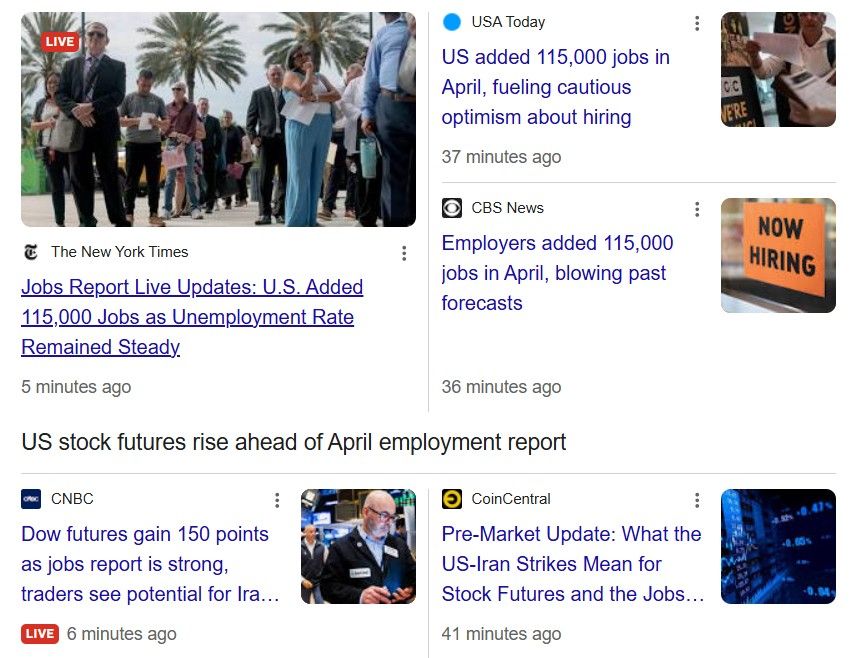
Total nonfarm payroll employment edged up by 115,000 in April, and the unemployment rate was unchanged at 4.3 percent, the U.S. Bureau of Labor Statistics reported today. Job gains occurred in health care, transportation and warehousing, and retail trade. Federal government employment continued to decline. This news release presents statistics from two monthly surveys.
The household survey measures labor force status, including unemployment, by demographic characteristics. The establishment survey measures nonfarm employment, hours, and earnings by industry. For more information about the concepts and statistical methodology used in these two surveys, see the Technical Note.
Household Survey Data
The unemployment rate was unchanged at 4.3 percent in April, and the number of unemployed people changed little at 7.4 million. Both measures changed little over the year. Among the major worker groups, the unemployment rates for adult men (4.0 percent), adult women (3.9 percent), teenagers (14.4 percent), and people who are White (3.7 percent), Black (7.3 percent), Asian (3.3 percent), or Hispanic (5.0 percent) showed little change in April.
The number of people jobless less than 5 weeks increased by 358,000 to 2.5 million in April. The number of long-term unemployed (those jobless for 27 weeks or more) was essentially unchanged at 1.8 million and accounted for 25.3 percent of all unemployed people. Both the labor force participation rate, at 61.8 percent, and the employment-population ratio, at 59.1 percent, changed little in April. These measures edged down over the year after accounting for annual population control adjustments.
The number of people employed part time for economic reasons increased by 445,000 to 4.9 million in April. These individuals would have preferred full-time employment but were working part time because their hours had been reduced or they were unable to find full-time jobs. The number of people not in the labor force who currently want a job changed little at 6.1 million in April. These individuals were not counted as unemployed because they were not actively looking for work during the 4 weeks preceding the survey or were unavailable to take a job.
Among those not in the labor force who wanted a job, the number of people marginally attached to the labor force changed little at 1.8 million in April. These individuals wanted and were available for work and had looked for a job sometime in the prior 12 months but had not looked for work in the 4 weeks preceding the survey. The number of discouraged workers, a subset of the marginally attached who believed that no jobs were available for them, was also little changed in April at 475,000. (See Summary table A.) Establishment Survey Data Total nonfarm payroll employment edged up by 115,000 in April, after showing little net change over the prior 12 months. In April, job gains occurred in health care, transportation and warehousing, and retail trade. Federal government employment continued to decline.
In April, health care added 37,000 jobs, in line with the average monthly gain of 32,000 over the prior 12 months. Over the month, job gains occurred in nursing and residential care facilities (+15,000) and home health care services (+11,000). Transportation and warehousing employment increased by 30,000 in April, reflecting a gain in couriers and messengers (+38,000). However, employment in transportation and warehousing is down by 105,000 since reaching a peak in February 2025. Retail trade added 22,000 jobs in April. Employment increased in warehouse clubs, supercenters, and other general merchandise retailers (+18,000) and in building material and garden equipment and supplies dealers (+13,000).
These gains were partially offset by job losses in department stores (-7,000) and in electronics and appliance retailers (-2,000). Retail trade employment had shown little net change over the prior 12 months. Employment in social assistance continued to trend up in April (+17,000), reflecting a gain of 24,000 jobs in individual and family services. Federal government employment continued to decline in April (-9,000). Since reaching a peak in October 2024, federal government employment is down by 348,000, or 11.5 percent.
Federal employees on furlough during the partial government shutdown were counted as employed in the establishment survey because they worked or received (or will receive) pay for the pay period that included the 12th of the month. Employment in information continued to trend down in April (-13,000). Telecommunications lost 3,000 jobs, while employment continued to trend down in motion picture and sound recording industries (-6,000) and in computing infrastructure providers, data processing, web hosting, and related services (-4,000). Information employment is down by 342,000, or 11.0 percent, since its most recent peak in November 2022.
Employment showed little change over the month in other major industries, including mining, quarrying, and oil and gas extraction; construction; manufacturing; wholesale trade; financial activities; professional and business services; leisure and hospitality; and other services. In April, average hourly earnings for all employees on private nonfarm payrolls rose by 6 cents, or 0.2 percent, to $37.41. Over the year, average hourly earnings have increased by 3.6 percent. In April, average hourly earnings of private-sector production and nonsupervisory employees rose by 11 cents, or 0.3 percent, to $32.23.
The average workweek for all employees on private nonfarm payrolls edged up by 0.1 hour to 34.3 hours in April. In manufacturing, the average workweek edged up by 0.1 hour to 40.4 hours, and overtime was unchanged at 3.0 hours. The average workweek for production and nonsupervisory employees on private nonfarm payrolls remained at 33.8 hours. The change in total nonfarm payroll employment for February was revised down by 23,000, from -133,000 to -156,000, and the change for March was revised up by 7,000, from +178,000 to +185,000.
With these revisions, employment in February and March combined is 16,000 lower than previously reported. (Monthly revisions result from additional reports received from businesses and government agencies since the last published estimates and from the recalculation of seasonal factors.)
Source: bls.gov