
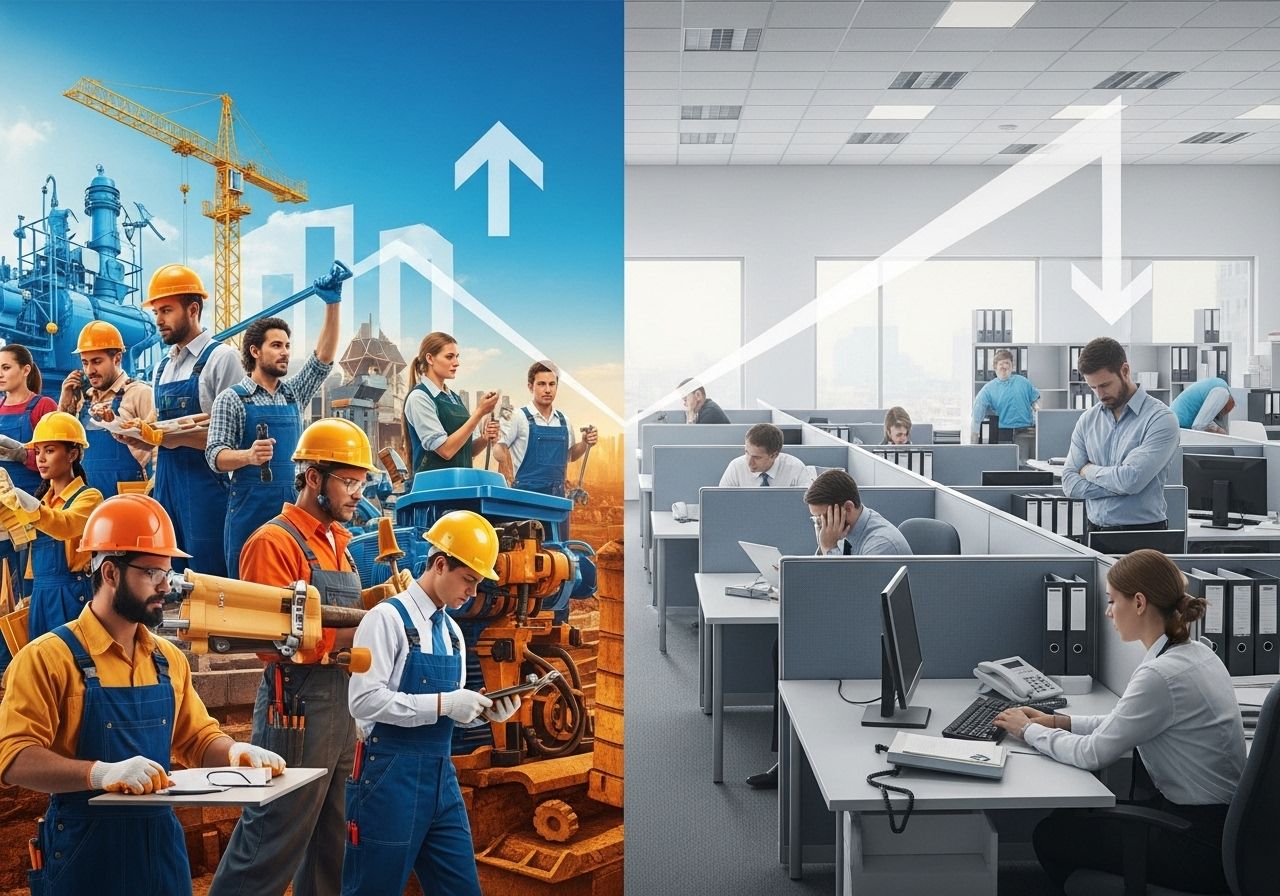
Jobs: Blue-collar Surges while White-collar Shrinks
For decades, white-collar jobs were seen as the pinnacle of economic security. But in 2026, those roles are under siege from automation and artificial intelligence. Entry-level analysts, paralegals, customer support staff, and junior consultants are among the hardest hit. A McKinsey analysis estimates that 12 million U.S. workers may need to switch occupations by 2030 due to AI and automation, with the steepest losses in office support and administrative roles.¹
In contrast, blue-collar work is experiencing a renaissance. According to the National Association of Manufacturers, 600,000 manufacturing jobs were unfilled in 2025, and shortages could double by the end of the decade.² Infrastructure investment, the clean energy boom, and reshoring of supply chains are fueling this demand. Wages in skilled trades are rising faster than in professional services: construction and extraction roles saw an 8% average pay increase in 2025, surpassing many white-collar fields.³
Gen Z is responding with pragmatism. Surveys show that nearly half of Gen Z high school graduates are considering trade schools instead of four-year colleges.⁴ The reasons are clear: trades offer shorter training times, less debt, and immunity from AI disruption. Electricians, welders, HVAC technicians, and solar installers cannot be replaced by chatbots or algorithms.
Companies are adapting. Caterpillar, Siemens, and Toyota have expanded apprenticeship pipelines. Amazon has begun retraining warehouse workers for technical maintenance roles. State governments in Ohio, Texas, and Florida are ramping up subsidies for community college programs in logistics and energy trades.
This workforce divergence signals a fundamental shift. White-collar roles are concentrating at higher levels of strategy and creativity, while blue-collar careers are becoming gateways to financial stability and upward mobility. Organizations that fail to invest in vocational partnerships risk missing out on the workforce reshaping America’s economy.
Source: Workplace Intelligence